
Credit Score or Income: What Matters More for a Mortgage?


By Kamal Parakh · Parakh Homes
Sources checked November 27, 2026
Both credit and income matter, but they answer different questions. Credit helps describe your borrowing history. Qualifying income and obligations help the lender assess repayment capacity. Neither a high salary nor an excellent score guarantees a particular mortgage rate or approval.
Watch the matching podcast clip
A short excerpt from Kamal’s mortgage conversation. Watch this Reel on Facebook. Read the article for current guidance, additional checks and the limits of any examples discussed.
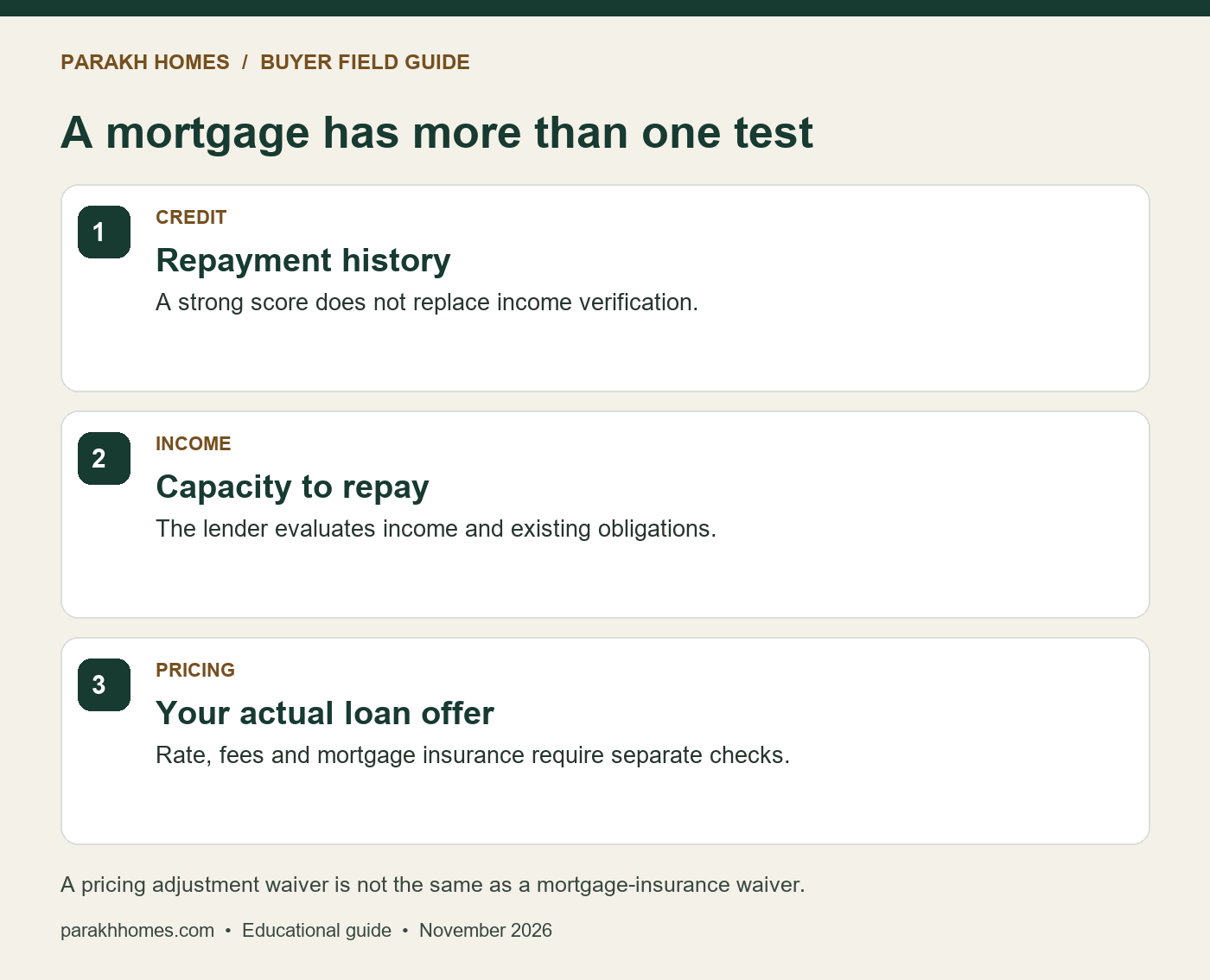
CREDIT
Repayment history
A strong score does not replace income verification.
INCOME
Capacity to repay
The lender evaluates income and existing obligations.
PRICING
Your actual loan offer
Rate, fees and mortgage insurance require separate checks.
A pricing adjustment waiver is not the same as a mortgage-insurance waiver.
The podcast clip raises a useful question about income-based mortgage pricing. Its specific income and loan-size examples should not be treated as today’s eligibility chart. The right next step is to identify the actual program and compare a written offer for your circumstances.
Separate approval, pricing and mortgage insurance
Think of three conversations with the lender. First: can this loan qualify? Second: what rate and fees are offered? Third: is mortgage insurance required, and how is it paid?
Federal ability-to-repay rules address factors including income or assets, employment where relevant, debts, credit history and repayment obligations. They do not turn one attractive number into a complete application. CFPB ability-to-repay rule.
In practice, ask the lender to name the issue it is solving. “Your score is fine” is different from “we have verified enough eligible income for this proposed payment.”
What is a loan-level pricing adjustment waiver?
Fannie Mae describes loan-level price adjustment, or LLPA, waivers for certain qualifying first-time buyers and other eligible transactions. An LLPA is a pricing component; it is not another name for private mortgage insurance. Fannie Mae’s financing FAQs.
Ask the lender:
- What is the program’s full name?
- Which address-based income limit applies, and which income figure are you testing?
- Does first-time-buyer status affect eligibility?
- What changes in this written quote if I qualify?
Do not use a remembered county income threshold from a video as proof that you qualify. Ask for the applicable limit and calculation for the actual property and application.
Does 5% down automatically mean no PMI?
No. CFPB explains that conventional borrowers with less than 20% down may be required to buy private mortgage insurance. Ask whether the quoted payment includes it, how it is paid and whether a different arrangement changes the interest rate. CFPB’s PMI explanation.
A quote without a separate monthly PMI line is a reason to ask how the loan is structured, not proof that every low-down-payment loan has become insurance-free.
Compare the same borrower and property scenario
Create a comparison note that keeps the purchase price, down payment, loan amount, loan term and property use constant. Ask each lender to show the rate, upfront lender costs, mortgage insurance and estimated cash to close for that scenario.
If one offer assumes a different program or down payment, label that difference before judging which offer is better. A low rate paired with substantial upfront costs solves a different problem from keeping more cash after closing.
A comparison that keeps pricing and approval separate
Imagine two quotes for the same buyer and property. One lender describes a pricing benefit for an eligible program. Another offers a different structure with a lower upfront cost. Before choosing, ask both to show the full payment and the actual eligibility assumptions. A program label does not settle the comparison.
Next, change just one input: the down payment. Ask whether that changes the loan amount, mortgage insurance, program eligibility or cash remaining after closing. Record the differences instead of judging the new scenario only by its rate. These are comparison steps, not a claim that increasing the down payment always produces the best outcome.
If income is near a program threshold, ask exactly which income figure counts. Household earnings, application income and program qualifying income should not be treated as interchangeable without the lender’s explanation. Request the relevant address-based limit and the rule being applied.
Finally, ask what happens if you do not qualify for the advertised benefit. You need a fallback offer you understand before building the home search around a favorable assumption. Keep the evaluated scenario and the conditional alternative clearly labeled in your own notes.
What should Northern Virginia buyers do first?
Tell the lender about your income structure and existing debts, then build a home search around the scenario the lender has evaluated. For Nepali and Indian buyers unfamiliar with US mortgage terminology, a short written explanation of “qualifying income,” “LLPA” and “PMI” can help the household compare offers without relying on an informal translation of a rate quote.
Our mortgage preapproval guide explains why the initial letter and the final loan decision can differ. Use it to prepare the next conversation, rather than treating your credit score as your whole buying budget.
Watch the full conversation
This article develops one topic from Kamal Parakh’s mortgage conversation. The added examples and checklists are educational tools, not the figures or outcome of an identified client’s loan. Watch the full episode on YouTube.
Build a shortlist around your actual plan
Tell Kamal your preferred Northern Virginia areas, essential home features and move timing. Have your lender confirm the financing assumptions.
Get my home shortlistKamal Parakh · Parakh Homes · Samson Properties · Equal Housing Opportunity. General education; loan eligibility, terms and property requirements depend on the program and your circumstances. Confirm financing with your lender and contract rights with an appropriate legal adviser.
Categories
Recent Posts